

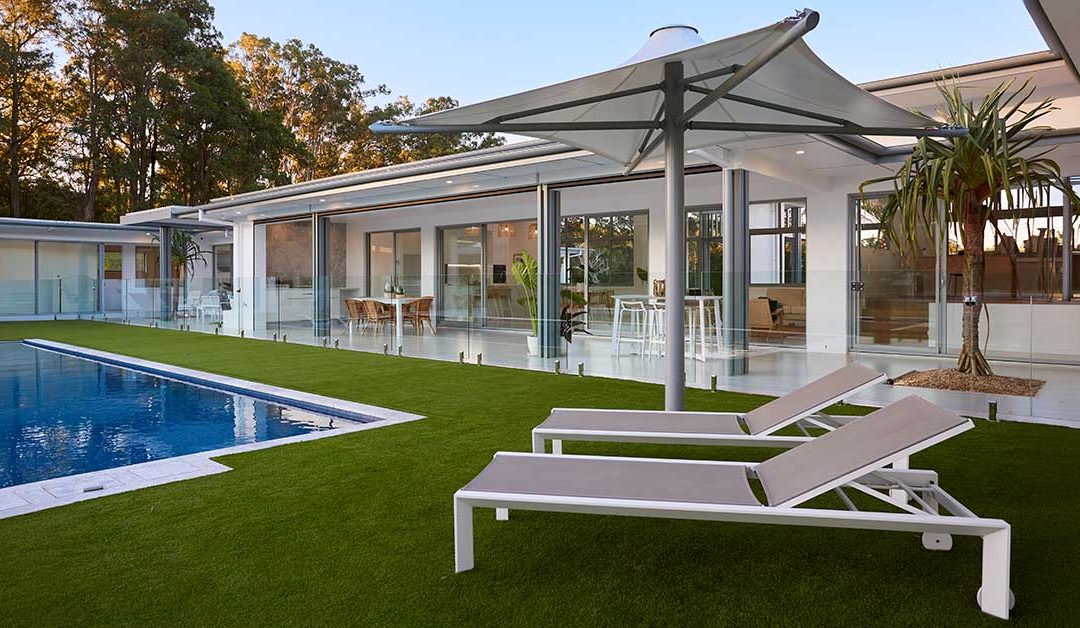
Stanhill Drive home completed 2004
Architecture, like fashion, is influenced by trends. Materials come and go, colours change, new technologies emerge and each decade develops its own recognisable architectural language.
Yet some houses seem remarkably immune to the passage of time.
A well-designed home can still look contemporary decades after it was completed, while another can begin to feel dated within only a few years.
Having worked as an architect for more than four decades, I’ve had the opportunity to revisit many of our earlier projects and see first-hand which design decisions have stood the test of time. It is particularly rewarding to return to a home 20 or 30 years after it was designed and discover that the architecture still feels relevant today.
So, what makes a house look timeless?
The answer is rarely a particular architectural style. Timeless home design is more often the result of good proportions, strong planning, appropriate materials and architecture that responds intelligently to its site, climate and occupants.
Timeless home design at a glance
- Start with a strong architectural idea
- Prioritise good proportion over fashion
- Avoid designing around short-lived trends
- Respond to the site and climate
- Choose materials that age gracefully
- Design from the inside out
- Allow the home to evolve
- Treat landscaping as part of the architecture
Start with a strong architectural idea
The most enduring homes usually have a clear architectural concept.
Rather than relying on applied decoration or fashionable details to create interest, the architecture itself provides the character. The relationship between solid walls and openings, roof forms, balconies, courtyards, projections and recesses creates the composition of the building.
A strong underlying form can survive changes in colour schemes, landscaping and interior decoration because the architecture doesn’t depend upon them.
This doesn’t mean a house needs to be simple or minimalist. Some of the most memorable homes are complex compositions. What matters is that there is an underlying order and rationale to the design rather than a collection of unrelated architectural features.

Good architecture doesn’t have to follow current trends to remain contemporary. (Chateau de Reves completed 2001)
Proportion matters more than fashion
Good proportion is one of the oldest principles of architecture and remains one of the most important.
The relationship between the height and width of a building, the scale of windows, the depth of balconies and overhangs, ceiling heights and even the dimensions of individual rooms all contribute to how comfortable and visually balanced a home feels.
These qualities aren’t particularly susceptible to fashion.
A beautifully proportioned room designed 30 years ago can feel just as comfortable today. Likewise, a well-composed elevation doesn’t suddenly stop working because a particular cladding material or colour is no longer fashionable.
When the fundamental proportions are right, architecture has a much better chance of ageing gracefully.

Avoid designing around short-lived trends
There is nothing inherently wrong with architectural trends. New materials, technologies and ideas continually improve the way we design and live in our homes.
Problems arise when a design becomes overly dependent upon whatever happens to be fashionable at the time.
Highly distinctive colour schemes, excessive use of a fashionable material or architectural features that have little purpose beyond creating a particular “look” can quickly identify when a house was designed.
We prefer to distinguish between design ideas and design fashions.
Ideas such as connecting indoor and outdoor spaces, introducing natural light deep into a home, creating cross ventilation or framing a particular view have lasting value.
A fashionable decorative treatment may not.
Timeless architecture therefore doesn’t need to be conservative. Quite the opposite. A house can be bold, contemporary and innovative while still being based upon enduring architectural principles.
Respond to the site
One of the best ways to create architecture that doesn’t date is to make the design specific to its location.
Every site has particular characteristics: orientation, views, prevailing breezes, neighbouring buildings, topography, vegetation and street context.
When the design responds directly to these conditions, many architectural decisions become logical rather than stylistic.
A deep overhang may protect western glazing from afternoon sun. A courtyard might provide privacy from a neighbouring property. An upper level may be angled to capture a view. A curved balcony might respond to the shape of a site or maximise an outlook.
These elements have a reason for being there.
Because they are generated by the site rather than fashion, they are less likely to become visually obsolete.
This is particularly important in Gold Coast and South East Queensland architecture, where climate should have a major influence on residential design. Shade, ventilation and generous connections between indoor and outdoor living aren’t simply stylistic choices; they are fundamental to creating comfortable homes for our subtropical environment.

Choose materials that age gracefully
Material selection plays an enormous role in how a house ages.
Some materials develop character over time. Others require constant maintenance to preserve the appearance they had when first installed.
Natural stone, masonry, timber, concrete, metal and glass have been used in architecture for generations. Their detailing may evolve, but the materials themselves don’t necessarily belong to a particular decade.
This doesn’t mean limiting a project to traditional materials. Contemporary products can perform exceptionally well. The important questions are how they will weather, how much maintenance they require and whether their appearance depends upon a short-lived design trend.
There is also value in restraint.
Using a limited palette of complementary materials generally produces a more cohesive and enduring result than introducing numerous finishes simply to create visual interest.

Shearwater Esplanade home completed 1997
Design from the inside out
A timeless house isn’t only about how it looks from the street.
Some of the most important qualities of good residential architecture are experienced rather than photographed.
How do you enter the house? Where does your eye travel when the front door opens? How does morning light enter the kitchen? Can living spaces open naturally to the garden? Are private rooms protected from neighbouring properties? Can the house accommodate changing family circumstances?
These planning decisions can remain relevant for generations.
Technology changes. Kitchens are replaced. Bathrooms are renovated. Furniture comes and goes.
But a fundamentally good floor plan can survive all of those changes.
This is one reason we place so much emphasis on understanding how our clients actually want to live before developing the architecture around them.

Allow a home to evolve
Few homes remain completely unchanged throughout their lives.
Families grow, children leave home, owners age and technology introduces requirements that may not have existed when the house was originally designed.
Good architecture should have enough flexibility to accommodate some of these changes.
Rooms with sensible proportions can be repurposed. Generous circulation can accommodate changing accessibility requirements. Well-positioned service areas can make future renovations easier.
Timeless home design therefore isn’t about creating a building that never changes. It is about creating a strong architectural framework that can accommodate change without losing its essential character.
Landscaping is part of the architecture
One of the most interesting aspects of revisiting an older project is seeing how its landscape has matured.
A newly completed house can sometimes appear exposed. Twenty years later, established trees and gardens soften the architecture, provide shade and create privacy that simply wasn’t possible when the project was photographed at completion.
This is why landscape should be considered as part of the original architectural concept rather than as decoration added at the end.
The best homes often improve with age because the architecture and landscape gradually become more integrated.

Mature landscaping can transform a home over time, allowing the architecture and its setting to become increasingly integrated. (Cannes Avenue home completed 1995)
Timeless doesn’t mean traditional
Perhaps the greatest misconception about timeless architecture is that it must look traditional.
It doesn’t.
Many of the houses designed by the great modern architects of the twentieth century remain remarkably contemporary today. They weren’t designed to imitate the past. They were innovative buildings based upon strong ideas, good proportions, honest materials and an understanding of how people live.
The same principle applies to contemporary residential architecture.
When designing a custom home, our objective isn’t to predict what architectural style might be fashionable in another 20 years. It is to design homes that are appropriate to their owners, their site and their climate while avoiding unnecessary elements that exist purely because they happen to be fashionable today.
The real test of good residential architecture
Perhaps the ultimate test of a house isn’t how it photographs on the day it is completed.
It is how it looks and functions 10, 20 or even 30 years later.
Having practised architecture for more than four decades, it is particularly rewarding to revisit earlier projects and find that, despite inevitable changes to landscaping, interiors and finishes, the fundamental architecture still feels relevant.
That longevity rarely comes from following a particular style.
It comes from getting the fundamentals right: proportion, planning, orientation, materials, climate and a strong architectural idea.
Trends will continue to change.
Good architecture doesn’t need to chase them.
Frequently asked questions
What makes a house look timeless?
A house looks timeless when it is built on good proportions, strong planning, appropriate materials and a clear architectural idea that responds to its site, climate and occupants. It rarely comes down to a particular architectural style.
Does a timeless house have to look traditional?
No. Timeless architecture doesn’t need to look traditional or conservative. A house can be bold, contemporary and innovative while still being based on enduring principles such as good proportion, honest materials and an understanding of how people live.
What materials age well on a house?
Natural stone, masonry, timber, concrete, metal and glass tend to age well because they don’t belong to a particular decade. A limited palette of materials that work together usually produces a more cohesive and enduring result than numerous finishes.
How do you stop a new house from looking dated?
Avoid designing around short-lived trends. Highly distinctive colour schemes, overuse of a fashionable material and features that exist only to create a “look” can quickly date a home. Focus on lasting ideas such as natural light, cross ventilation and indoor-outdoor connection.
Why does climate matter for timeless home design on the Gold Coast?
In the Gold Coast’s subtropical climate, shade, ventilation and generous indoor-outdoor connections are fundamental to comfort, not stylistic choices. Design elements that respond to the site and climate have a reason for being there, so they are less likely to look dated.
About the author
John Lea is a registered architect and the founder of Lea Design Studio, an award-winning residential architecture practice on the Gold Coast. With more than four decades of experience, he has been recognised as one of the Top 3 Gold Coast Architects every year from 2019 to 2026.
You might also be interested in...
7-Star Gold Coast Homes: Stay Cool, Live Smarter
All new homes built in Australia must meet a 7-star energy rating. Here’s what that means for Gold Coast homeowners – and how smart design makes compliance straightforward.

Sustainable House Demolition Australia Best Practices
Learn sustainable house demolition practices in Australia. Discover how to recycle 90% of building materials.